
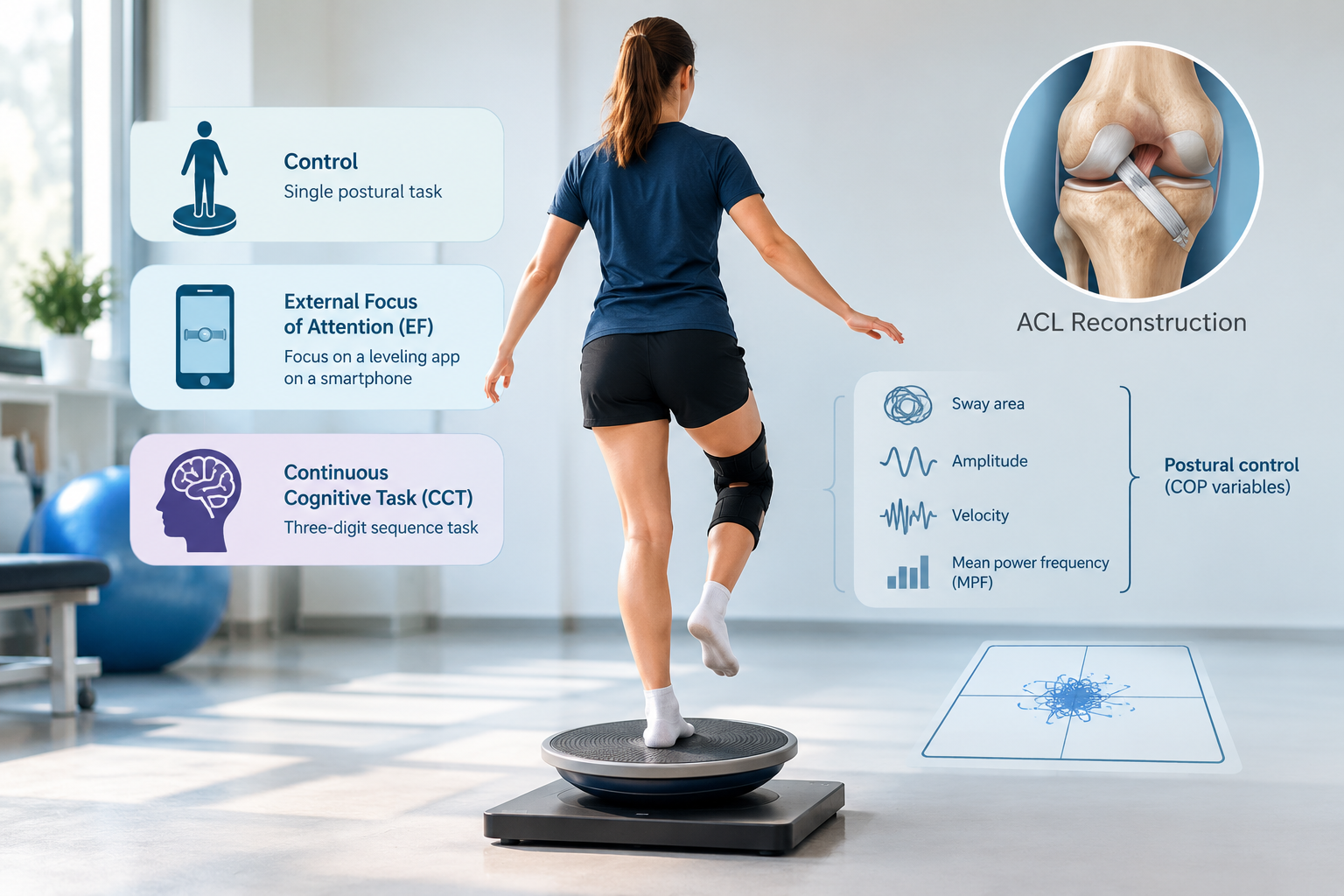
Materials & Methods: The present study is a case-control study using simple non-probability sampling. Participants included 20 male football players with ACL reconstruction (13.90±4.15 months after surgery) and 20 healthy men. They were matched for age, sex, height, weight, body mass index, dominant leg, education and activity levels. Tegner activity level scale was used to determine activity level of participants. Postural control was evaluated under single-leg stance test (with treated leg) on firm and foam surfaces with and without continuous cognitive task. Balance error scoring system was used to assess the balance control. In the condition without cognitive task, no feedback was provided. Continuous cognitive task consisted of 10 three-digit numbers each presented with a 2-second interval by audio tape and headphone. In the cognitive condition, individuals were asked to focus on the preselected number and provide the sum of its repetitions in the end of the test. The dependent variable was the number of balance error in each condition. Balance errors included lifting hands from hip, opening eyes, stepping or swinging, lifting forefoot or heal, moving hip into more than 30 degrees of hip abduction or flexion, and remaining out of position for more than 5 seconds. We used SPSS v. 20 software for statistical analysis of data. Kolmogorov- Simonov test was performed to test the normality of data distribution. Intraclass Correlation Coefficient (ICC) was calculated to assess the relative reliability of the rater for assessing the balance error. The absolute reliability of the rater was measured using Standard Error of Measurement (SEM), Minimal Metrically Detectable Change (MMDC) and Coefficient of Variation (CV). Mixed-model of ANOVA (2 groups ×4 stance conditions) was used to investigate the main effect and interaction effect of these factors. We used repeated measure ANOVA to determine the main effect of test condition in every each, and independent-sample t-test and effect size was used to determine the difference between groups.
Results: Distribution of data in all four test conditions was normal (P>0.05). The rater reliability was excellent for calculating the balance error in all test conditions (ICC>0.90, MMDC<%10 and CV<%5). Interaction between group and test condition was significant (F=11.59, P<0.01). Result of independent-sample t-test showed that subjects had a higher balance error than healthy subjects under single-leg stance test on foam without cognitive task (F=2.01, p<0.01). In this condition, the effect size also showed that difference between groups was large (>0.8).The main effect of test condition in subjects showed that the continuous cognitive task reduced balance error while standing on both firm and foam surfaces (P<0.01), while in healthy subjects, the cognitive task had no effect on the balance (P>0.05).
Conclusion: It can be concluded that male football players with ACL reconstruction had poorer stability compared to healthy subjects in performing single-leg stance test on foam surface without continuous cognitive task. Moreover, continuous cognitive task improved balance control in ACL subjects, while it had no effect on the balance of healthy subjects.
The Effects of Continuous Cognitive Task on Postural Control of People with Anterior Cruciate Ligament Reconstruction Using Balance Error Scoring System
The Effects of Continuous Cognitive Task on Postural Control of People with Anterior Cruciate Ligament Reconstruction Using Balance Error Scoring System
13 مهر 1405
Anterior cruciate ligament reconstruction
Postural balance
Balance error scoring system
Attention
دکتر پیام احمدی
فیزیوتراپیست پیام احمدی
فیزیوتراپی التیام
بازسازی رباط صلیبی قدامی
آسیب ACL
کنترل تعادل پس از ACL
تعادل تکپا
کنترل پاسچر
تعادل پویا
کنترل عصبی عضلانی
توانبخشی رباط صلیبی
فیزیوتراپی ورزشی
بازیکنان فوتبال
بازگشت به ورزش
فعالیت شناختی و تعادل
تداخل شناختی پاسچر
ثبات زانو
فیزیوتراپی بعد از جراحی ACL
توانبخشی زانو
فیزیوتراپیست اهواز
دکتر پیام احمدی
 دسته بندی مطالب
مطالب مشابه
۱۴۰۵/۰۷/۱۳
دیدگاهها