
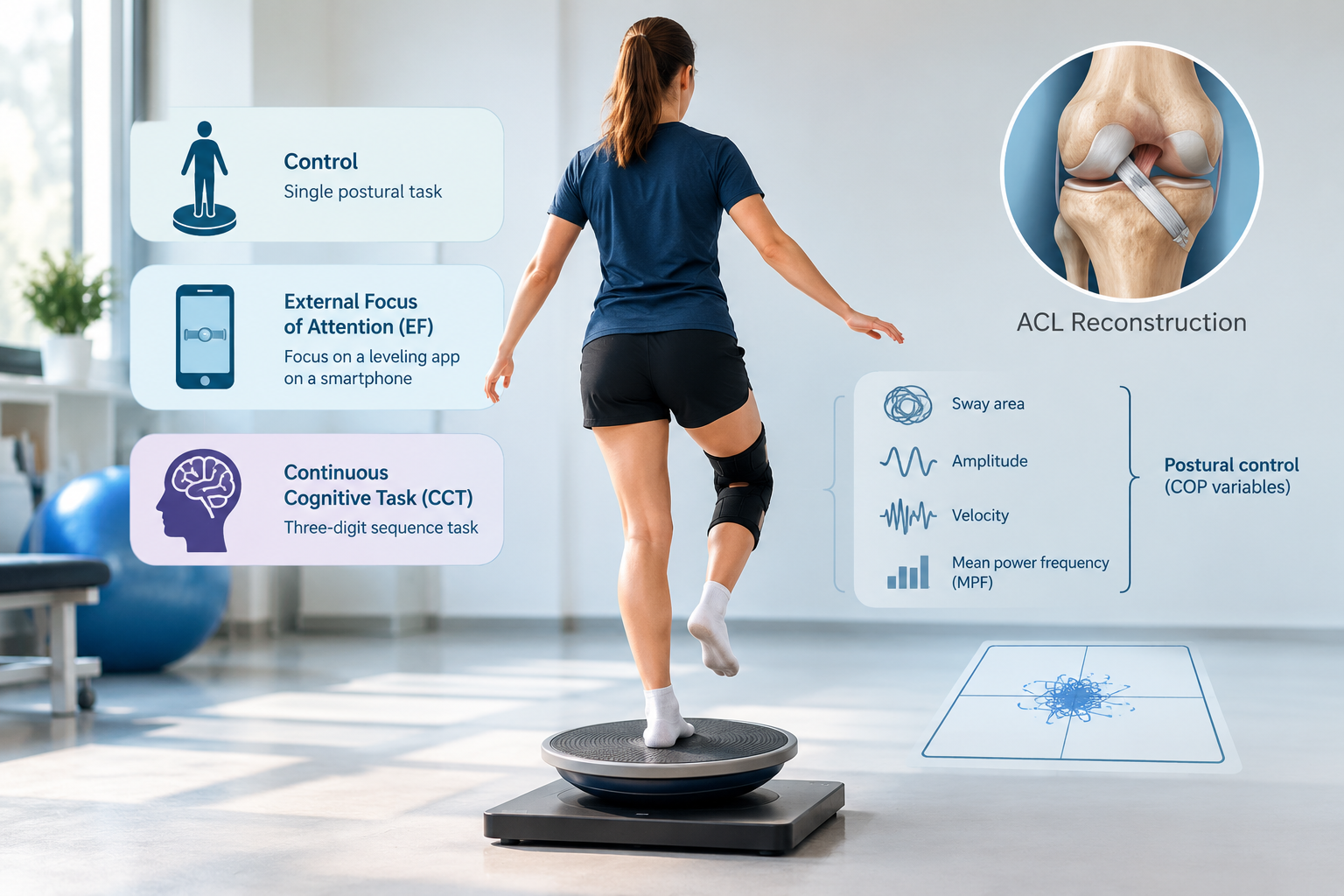
postural task with EF of attention (focusing on a planar leveling app in a smartphone placed on the wobble board) and postural task concurrent with CCT (three-digit sequence task). Measurement parameters, including sway area, amplitude, velocity, and mean power frequency (MPF), were the traditional center of pressure (COP) variables. A significant difference was found between ACL-R athletes and healthy subjects for the AP amplitude in the control condition as well as the ML amplitude in the CCT condition. Furthermore, in the ACL-R group, cognitive demand significantly decreased postural sway, while postural sway was not different between the conditions for the healthy group. Results also indicated that CCT significantly decreased sway velocity and increased mean power frequency in both groups, while EF of attention did not change any COP measures. Concurrent CCT decreases postural sway in ACL-R athletes, while it does not have significant effects on healthy subjects. EF of attention did not affect postural control in both study groups.
Comparing the effects of external focus of attention and continuous cognitive task on postural control in anterior cruciate ligament reconstructed athletes
Comparing the effects of external focus of attention and continuous cognitive task on postural control in anterior cruciate ligament reconstructed athletes
13 مهر 1405
 دسته بندی مطالب
مطالب مشابه

۱۴۰۵/۰۷/۱۳


دیدگاهها