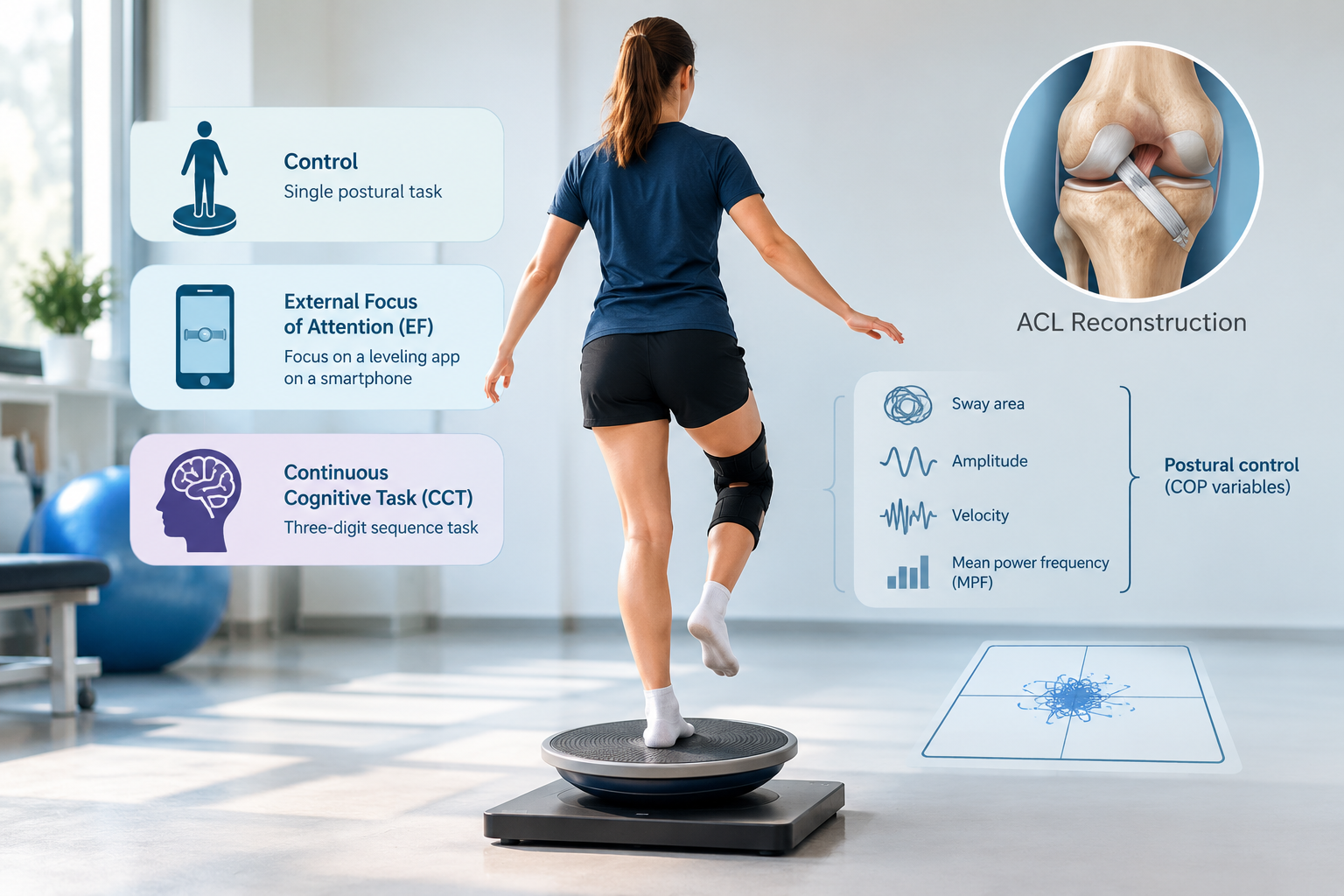
Anterior cruciate ligament (ACL) injury that accounts for 50% of all knee ligamentous injuries [1] commonly occurs in recreational and competitive sports activities [4]. ACL-reconstruction (ACL-R) surgery is usually recommended for those individuals who wish to return to full functional activities including sports participation [7], [9], [10]. Regaining neuromuscular control especially optimal postural control, after ACL-R surgery, is an important prerequisite for a safe return to sports activities [5].
Howells et al. [7], in a recent systematic review, reported a trend toward impaired postural control during quiet standing in patients with ACL-R compared to healthy controls. As this impairment was more apparent and also more consistent in dynamic balance conditions (relative to static ones), they recommended evaluation of postural performance under dynamic conditions of standing balance for future studies [7]. A decrease in either of the sensory (i.e. proprioceptive deficit) or motor (i.e. muscle weakness) system functions has been proposed to be associated with impaired postural control in patients with ACL-R. However, the role of cognitive (attentional) process as a third component of postural control system remained unclear in this patient population.
To investigate the role of attentional process invested in postural control, a dual-task paradigm in which a postural task was performed simultaneously with an attention challenging cognitive task was used [2], [19]. According to limited capacity theory of attention, if simultaneous execution of standing balance control and cognitive task occupies attention more than the existing capacity, performance deterioration of one or both tasks would occur. Such performance deterioration is known as posture-cognition interference [19]. Based on this rationale, some studies have investigated the effects of performing a secondary cognitive task on postural control of patients with different musculoskeletal disorders such as ACL injury [11], low back pain (LBP) [15] and functional ankle instability (FAI) [14]. Posture-cognition interference was only reported in the FAI in which standing balance control was evaluated on dynamic platform of the Biodex Balance System (BBS) [14]. No interference was seen for the ACL-injured and LBP patients in whom postural control was assessed during standing on static platform of a fixed force plate [11], [15]. Those researchers recommended using more challenging dynamic balance conditions for future investigation on posture-cognition interaction.
In the current study, it was hypothesized that the pattern of posture-cognition interaction in dynamic balance conditions may be different in patients with ACL-R compared to healthy individuals. However, to our knowledge, no study has yet investigated this interaction. Therefore, the aim of this study was to investigate the amount of attentional demands of postural control in patients with ACL-R by comparing the pattern of posture-cognition interaction between two groups of patients and healthy matched controls while participants were standing on a dynamic platform of a balance board.